
On the strange usefulness of going out on the water with no plan and no shore in mind
01The argument against arriving
There is a small rowing boat pulled up on most lake shores — weathered, half-filled with last night's rain, one oar longer than the other. You drain it with a coffee tin. You fit the oars into their rusted pins. You push off.
Nobody asks where you're going. That's the first relief.
For people whose days are structured around destinations — the meeting, the milestone, the next thing after the next thing — this is a more radical act than it looks. A rowing boat without a destination is a small, gentle argument against the entire logic of forward motion. You face the shore you've just left. You go backwards. You can't see where you're heading, only where you've been, and after ten minutes of steady pulling, where you've been has grown quiet and small and it no longer matters very much.
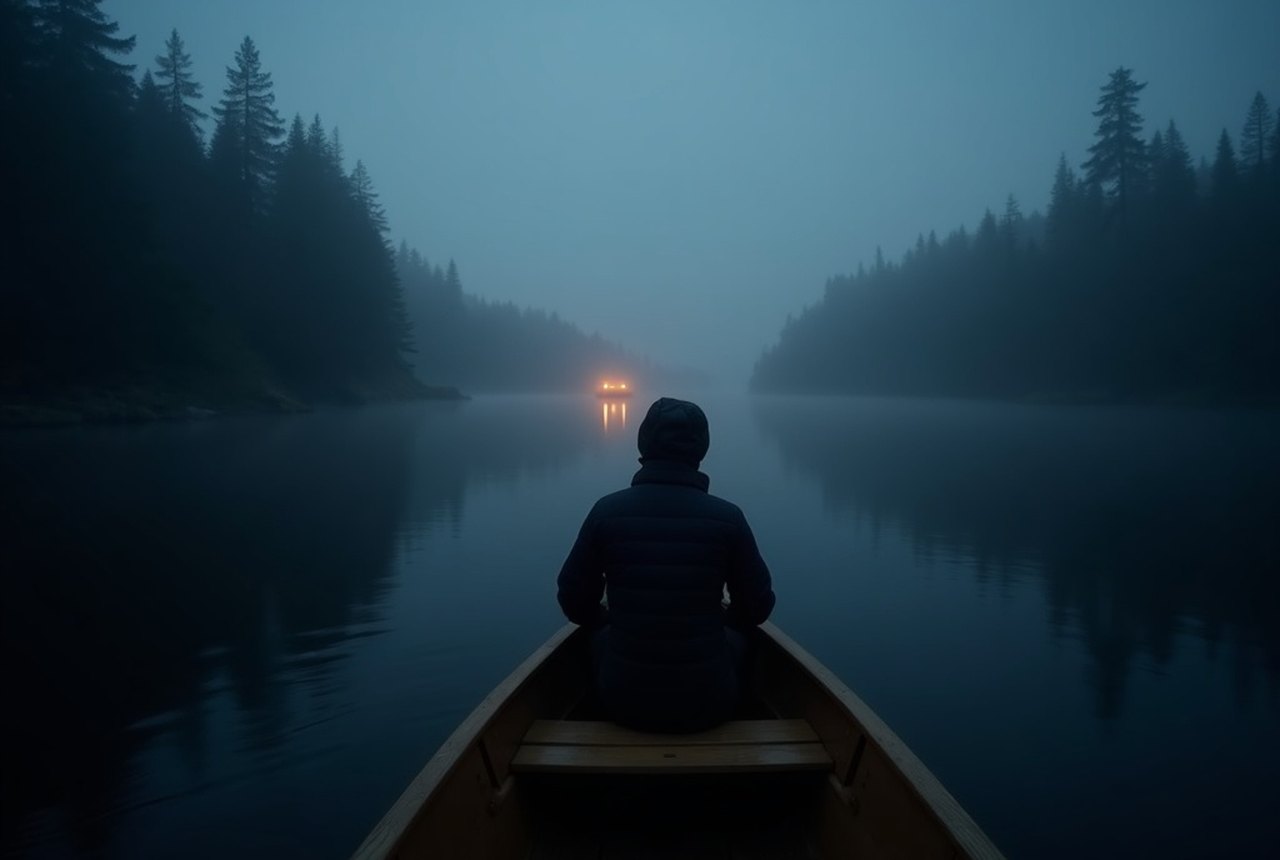
The rhythm finds you quickly, if you let it. Reach, pull, recover. The oar blades catch — that slight resistance before the water gives — and then the glide: the few seconds when the boat runs on its own and you can let your hands rest and listen. The hull makes a low sound against its own wake. The water behind you is briefly chaotic, then smooths. Reach, pull, recover. It is as close to a blank mind as most people manage.
A rowing boat without a destination is a small, gentle argument against the entire logic of forward motion.
02What the drift teaches
At some point you will stop rowing. Not because you've arrived — you haven't — but because the arms want to rest and the lake seems to be suggesting something. You ship the oars. The boat slows, turns lazily in some private wind, and settles.
This is the part that unsettles people at first: the aimlessness. We are not trained to be still and unproductive on the water in the middle of a working day, even when that working day is formally paused. The mind wants to justify the idleness, to reframe it as exercise or mindfulness or some other useful category. Resist that. The point is not the category. The point is the water and the sky and the strange fact that you are floating, doing nothing, going nowhere, and that nothing, for the moment, is required of you.
The philosopher Blaise Pascal wrote — in the seventeenth century, but it reads like this morning — that all of humanity's problems stem from the inability to sit quietly in a room alone. A rowing boat is not a room, but the same principle applies. The water holds the silence better than most rooms can. There is no signal. There is no ambient noise of the indoors — no refrigerator hum, no distant road. There is only the light shifting on the surface, the occasional ring where something fed, the far shore sitting in its trees.
Blaise Pascal
Philosopher · seventeenth century
French mathematician and philosopher. His Pensées locate most of humanity’s problems in one inability: sitting quietly in a room alone.
Referenced in this piece
You will start to notice small things. The way one bank lies in shadow while the other is bright. A heron that has been standing in the shallows so still you only see it when it lifts. The temperature gradient as a cloud passes — the warmth you didn't know you were feeling until it's briefly gone. The senses, deprived of the usual inputs, adjust and sharpen. This is not mysticism; it is simple neurology. Give the mind less noise, and it begins to attend.

Eventually you row back. Not because you want to, necessarily, but because the afternoon has moved without you and the lake has given you what it had to give. You beach the boat and pull it above the waterline and fit the oars back underneath the hull where you found them.
The water closes over where you were. In ten minutes there will be no sign of it.
That erasure is part of the point. A row on the lake leaves nothing — no record, no output, no result that can be measured or reported. It is private in a way that almost nothing else is. Something that happened between you and the water and an afternoon that is now finished. You can keep it or not; it doesn't matter either way. You went out. You came back. The gap in between was yours.