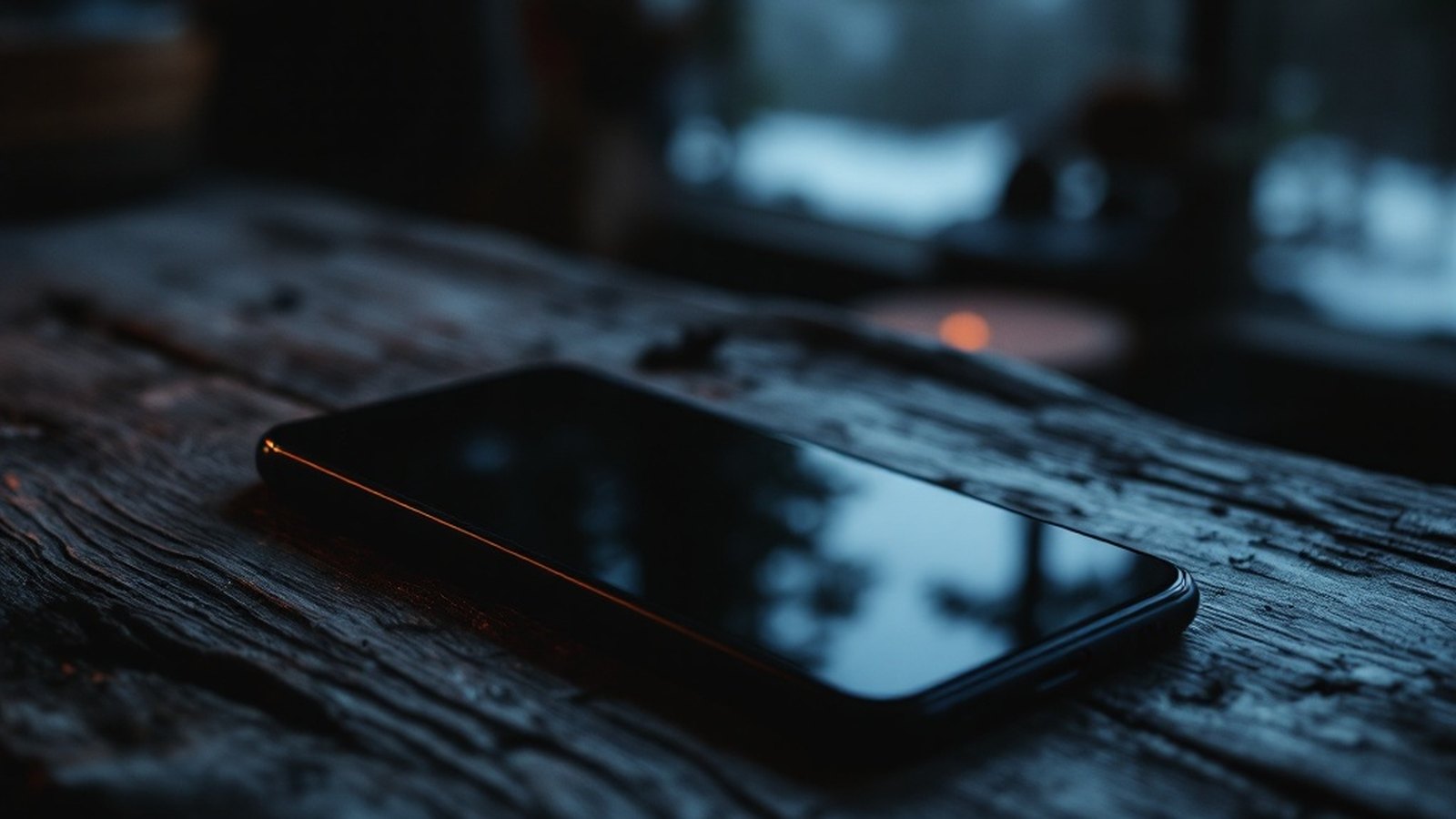
Disappearing is not irresponsibility. It is, when done honestly, one of the more considered things you can do.
01The honest out-of-office
There is a particular kind of lie we have all agreed to tell. It lives in the auto-reply, in the careful phrasing that says I am away from my desk rather than I have decided, temporarily, to stop being available to you. The first sounds like an accident. The second sounds like a choice. And we have been taught, with some thoroughness, to be afraid of the second.
So we soften it. We write limited access to email when we mean no access, by design. We add for urgent matters, please contact — and then we name someone, handing our silence to a colleague like a coat we are too nervous to keep. We set the tone of our absence as apologetic before it has even begun. The out-of-office becomes not a declaration of rest but a pre-emptive negotiation, a promise that we are not really gone, only slightly relocated, still reachable if the stakes are high enough.
The honest version would say: I am away. I will not be checking this. Everything that matters will wait, or will be handled without me. Most of us cannot quite bring ourselves to write it. But that is, more or less, the truth — and it is worth sitting with the reason we flinch from it.
The honest auto-reply, in full: I am away. I will not be checking this. Everything that matters will wait, or will be handled without me.
The flinch is not really about logistics. It is about identity. For a significant proportion of people who find themselves burnt out and dreaming of a ridge, a cabin, a lake with no signal, the deepest anxiety is not what if something goes wrong but what if nothing does. What if the thing runs fine without you? What if no one, in forty-eight hours, sends the email that begins we really need you? That is not a logistical fear. That is an existential one, and it deserves a more honest examination than the usual out-of-office prompt allows.
02Who actually needs you
Here is a useful exercise, and not a comfortable one. Take the last week of messages that felt urgent, the ones that landed in the evening or pulled you sideways during a meal, and ask, plainly: who actually needed me here, and who merely wanted access to me?
The distinction is a real one, even if we collapse it habitually. Need implies that without your specific input, something fails — a decision cannot be made, a person is in genuine distress, something with actual consequences stalls. Want implies that your availability is convenient, reassuring, or simply a habit the other person has formed because you have never declined to be there. Most of what arrives as urgent belongs to the second category. Not all of it — but most.
| Need | Want |
|---|---|
| A decision genuinely stalls without your specific judgment | Your availability is convenient, so things route to you |
| Someone is in real distress and needs your full attention | Your reachability is reassuring, a habit others have formed |
| Something with actual consequences fails | You have simply never declined to be there |
This is not cynicism about the people in your life. It is a structural observation about how availability works. When you are reliably reachable, people route things to you that they are perfectly capable of resolving without you. They do it without malice. They do it because you are there, because the friction of reaching you is low, because your presence has become load-bearing in ways that were never formally decided. Removing yourself temporarily does not abandon them. It redistributes, often to the person who was always capable of carrying it.
The ones who genuinely need you — who need your specific judgment, your knowledge, your relationship — can usually wait two days. And if they cannot, they are not people a single check of your phone will help; they require your full, present attention, which being half-in and half-out of a cabin weekend does not provide.
There is a relief available in this thinking, if you let it land. You are less indispensable than your anxiety insists, and more valuable when you are actually present than when you are nominally available from a distance. Disappearing, briefly and honestly, is not a dereliction. It is a recalibration — of yourself, and of the expectations that have quietly accumulated around you.
You are less indispensable than your anxiety insists — and more valuable when you are actually present.
03The last check and what lives on the other side of it
Anyone who has tried to go properly off-grid knows the moment: you are nearly there, the signal is dropping, and you pick up your phone for one final look. You tell yourself it is responsible. You tell yourself you are just making sure. What you are actually doing is delaying the threshold — standing in the doorway of your absence, one foot still inside.
The last check has its own particular texture of anxiety. The inbox is never clean; that is definitional. There will be something unresolved, something that could spiral into something else, something you cannot quite classify as fine. So you do a rapid triage — I'll just deal with this one — and then another, and the threshold recedes a little further. The cabin is three minutes away. You have been in the car park for twenty-five minutes.

What nobody tells you in enough detail is what happens after you walk through.
- The car parkOne final look becomes twenty-five minutes of rapid triage.
- The first hoursNot peaceful — loud with everything you left.
- The first walkThe legs do something the head cannot.
- At a pace you cannot scheduleThe signal drops — not just on the phone, in the body.
- The far sideAttention returns: curious, unallocated, entirely yours.
It takes time. That is the first, honest thing. The first hours in silence are not peaceful; they are loud with what you have left. The mind rehearses unfinished conversations, composes replies, runs unlikely disaster scenarios in which your absence is the pivot. This is normal. It is the nervous system doing what it has been trained to do — scanning for threat, preparing response — without the material to act on. You cannot rush it. You sit with it, or you walk into the treeline and let your legs do something your head cannot, and eventually, at a pace you cannot schedule, the signal drops not just on your phone but in your body.
And then there is the other side. It is not dramatic. It does not arrive as revelation. It is closer to the sensation of taking off a coat you had forgotten you were wearing — a lightness, a faint surprise that you were carrying that much. The lake does what the lake does. The ridge holds its silence. And you discover, perhaps again after a long interval, that your attention — unmonitored, unallocated, belonging entirely to you — is not anxious at all. It is curious. It notices things. It lingers without agenda. It is capable, it turns out, of something very close to pleasure.
04Disappearing honestly
The art of not being found is not about secrecy or self-dramatisation. You are not a fugitive. You have not vanished in any permanent or meaningful sense. You have simply, temporarily, declined to be at the end of a line — and that requires less justification than we have been persuaded to think.
What it does require is honesty: with the people you are temporarily leaving, with yourself about why it feels harder than it should, and with the expectations you have let calcify around your availability. Write the direct out-of-office. Name, to yourself, who actually needs you and who has simply come to expect you. Do not half-go — the person who checks twice a day from the far side of the lake is not resting; they are performing rest without receiving any of it. If you are going to do this, do it. Cross the threshold. Let the signal go.
There is a version of you that exists only when no one is looking for you. Not a better version, necessarily — not more productive, not more enlightened — but more fully yourself. Unhurried. Unperformed. Capable of noticing the quality of light at a particular hour, the way the cold comes off the water at dusk, the specific silence of a place where no one knows where you are.
That version of you is not a luxury. It is what you are actually like when the noise subsides. And it is worth the mildly uncomfortable process of becoming unreachable to find out.

So write the out-of-office that tells the truth. Put the phone in the bag. Walk into whatever you have found — the trees, the dark water, the ridge going grey at the edge — and give yourself the full experience of not being found.
It will feel strange for a while. Then it will feel like something you have always known.